From untracked pregnancies to real-time pregnancy surveillance
Maternal care platform for Uttar Pradesh: connecting frontline workers, facilities, and families through a single closed-loop ecosystem to reduce maternal deaths.
Challenge
Uttar Pradesh has a Maternal Mortality Ratio (MMR) of over 150 — 58% higher than the national average. The state accounts for roughly 8,000 maternal deaths annually, representing 33% of India's total. The State Transformation Commission (STC) set an ambitious target: reduce MMR below 20.
The fundamental barrier was not access to healthcare facilities — institutional delivery coverage had improved significantly. The challenge was coordination, timeliness, and accountability across a fragmented ecosystem of 1.6 lakh ASHAs, 35,000 ANMs, 975 CHCs, 3,750 PHCs, and thousands of private facilities.
Maternal mortality in high-burden states is not a single-point failure — it is a systems problem involving coordination gaps across registration, risk identification, transport, facility readiness, and post-delivery accountability.
Three systemic delays were driving preventable deaths:
Delay in registration and decision-making: Only 35–40% pregnancies registered. Families unaware of danger signs. No shared digital system across ASHA, ANM, and AWW.
Delay in reaching the facility: No ambulance pre-positioning for known high-risk cases. Referral did not automatically trigger transport.
Delay in receiving timely care: Facilities received no advance warning. No pre-arrival clinical summary. Blood bank and OT readiness unconfirmed until arrival.
Existing government portals (RCH, HMIS, e-Kavach) served as data-entry and reporting systems — none provided real-time care coordination, dynamic risk assessment, or closed-loop accountability. Critically, no dedicated digital system existed for pregnancy tracking and High-Risk Pregnancy management.
What We Found
In the absence of a dedicated pregnancy tracking system, significant gaps existed in how maternal care was coordinated:
- →No digital system to identify and flag High-Risk Pregnancies — let alone re-evaluate risk dynamically as the pregnancy progressed
- →No mechanism to track family engagement or responsiveness to health advisories
- →Referral workflows were incomplete — a referral was made but the outcome was never tracked back
- →No dedicated system for pregnancy registration meant non-Aadhaar populations (migrant families, never-enrolled women) had no path into digital tracking
- →No alert infrastructure — no way to notify multiple stakeholders or track response SLAs
- →MDSR (Maternal Death Surveillance) was retrospective and paper-based
- →No offline-capable tools for frontline workers in areas with unreliable connectivity
- →Frontline workers had to enter data into multiple disconnected systems, creating duplication and inconsistency
Approach
Rather than building another reporting portal, we designed Sankalp as a real-time care coordination platform connecting 10 roles across the maternal health ecosystem — from the pregnant woman on WhatsApp to the State War Room on a dashboard.
The core design principle: Sankalp would serve as the single source of truth for all pregnancy-related data, feeding information into existing government systems (RCH, HMIS, MPCDSR) without requiring frontline workers to duplicate efforts across multiple platforms.
The platform was built around three non-negotiable goals:
100% Registration: Every pregnancy known to the system, regardless of Aadhaar status, literacy, or device access.
100% HRP Identification: Dynamic risk engine that re-evaluates on every clinical update — not just at registration.
100% Institutional Delivery for HRP: Pre-planned, pre-routed, with facility readiness confirmed 30 days before EDD.
Delay 1 — Registration and Awareness
- →WhatsApp-based self-registration — no facility visit, no app install required
- →Deliberate inclusion of non-Aadhaar registration (Voter ID, Pradhan attestation, ASHA verification) — ensuring no woman is left without care regardless of document availability
- →IVR fallback for non-smartphone, illiterate beneficiaries
- →Unified case view — one registration visible to ASHA, ANM, and AWW instantly
- →Family engagement scoring — tracks husband/MIL responsiveness; flags low-engagement families for supervisor intervention
- →Proactive detection signals — missed period tracking, THR cross-reference, Nischay kit correlation
Delay 2 — Transport Coordination
- →Ambulance pre-positioning for all RED-flagged cases
- →One-tap dispatch — referral auto-triggers 102/108 ambulance
- →Real-time GPS tracking with ETA shared to facility, family, and War Room
- →Nearest-facility routing based on gynaecologist availability and C-section capability
Delay 3 — Facility Readiness
- →Facility readiness and status tracking — capacity, specialist availability, blood bank, OT status — visible at block, district, and state level
- →Pre-arrival alert sent to facility before patient arrives, enabling preparation
- →Monthly/weekly delivery planning visible to facility MO
- →Post-delivery feedback loop via WhatsApp for iterative quality improvement
HRP Risk Engine
- →Configurable rule engine tailored for UP's maternal health profile
- →Re-evaluates on every vitals/lab/USG update — dynamic risk assessment on each ANC visit
- →Flags escalate AND descend (system rewards successful treatment)
- →Deterministic, auditable, sub-50ms execution
- →Hindi voice explanation per flag for limited-literacy frontline workers
- →8-stakeholder simultaneous alert fan-out on every escalation, SLA-tracked, closed-loop
10Roles connected across the care ecosystem
100%HRP identification target via dynamic risk engine
75Districts planned for phased rollout
Results
Before
- ✕No digital system for pregnancy tracking or HRP management
- ✕35–40% pregnancies registered — majority invisible
- ✕Referrals made but outcomes never tracked back
- ✕Paper-based MDSR — retrospective, delayed
After
- →WhatsApp-based registration — no app install required
- →Dynamic HRP engine re-evaluates risk on every clinical update
- →Closed-loop SLA tracking from alert to outcome
- →One-tap MDSR notification replacing paper process
Sankalp was presented at the STC UP Hackathon in Lucknow (June 2026) by Kaarastu with a working prototype demonstrating the full closed-loop workflow — from WhatsApp registration to delivery outcome tracking.
Capabilities Delivered
- →Complete care coordination platform connecting beneficiary, frontline workers, facilities, dispatch, and administration
- →Dynamic HRP engine that identifies risk escalation mid-pregnancy — not just at first visit
- →Inclusion-first design serving women with no Aadhaar, no smartphone, and no literacy
- →Closed-loop SLA tracking — every alert tracked to acknowledgement and outcome
- →One-tap MDSR notification (MPCDSR-compatible) replacing manual, delayed paper-based processes
- →Bilingual (Hindi/English) across all surfaces with role-appropriate defaults
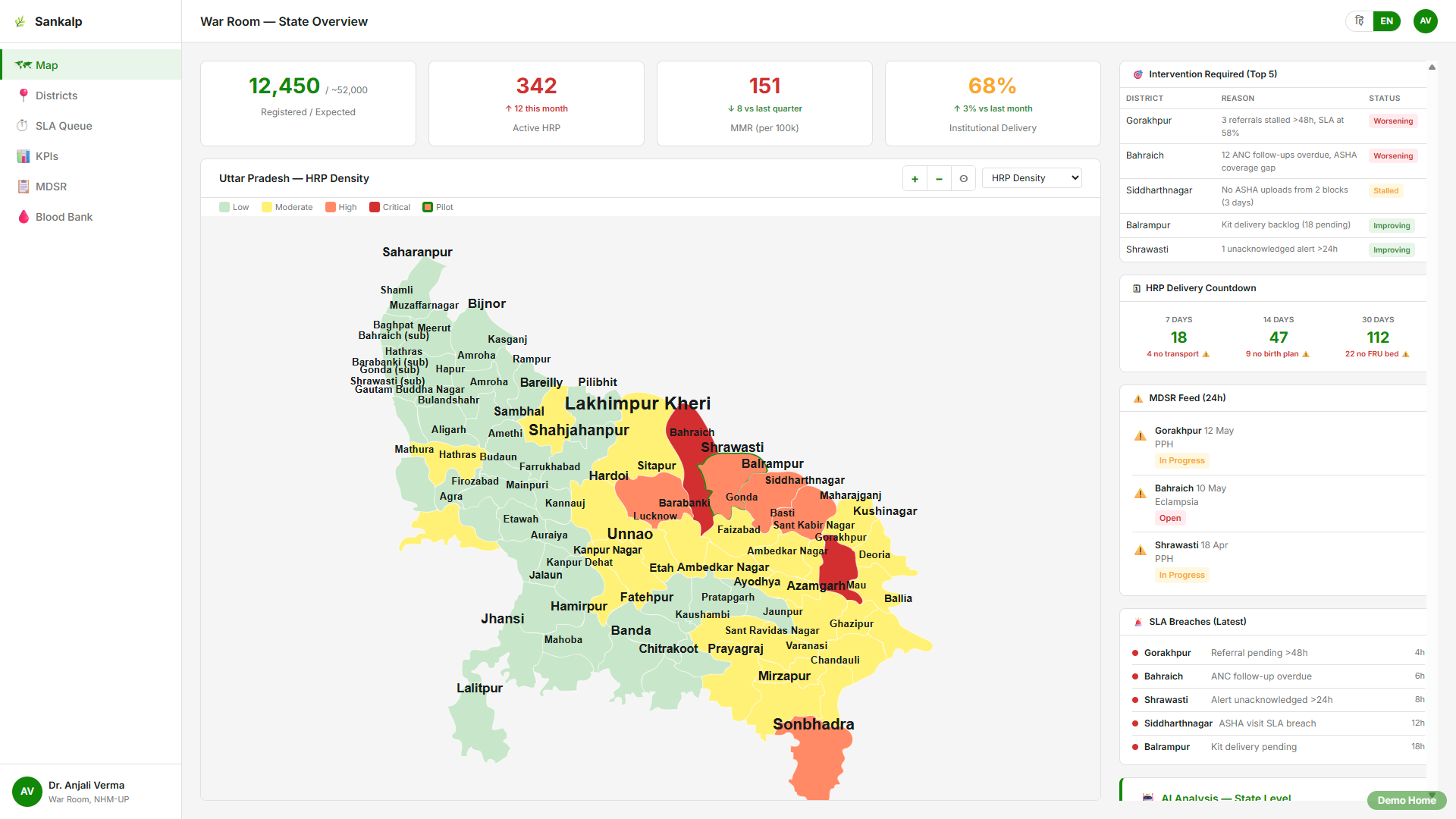
- →State War Room with district-level drill-down, real-time HRP surveillance, and SLA breach escalation
The platform is designed to scale from pilot (2 districts) to all 75 UP districts over a 24-month phased rollout, with a replication model for other states.
Our Perspective
Technology interventions that address only one layer (reporting, or alerts, or tracking) leave the remaining gaps open. Sankalp was designed as an end-to-end coordination layer — one that connects every stakeholder, tracks every pregnancy to outcome, and closes every loop. The goal is not another dashboard. The goal is that no pregnancy goes untracked and no family is left without timely care.
Ask about experience in your industry.
Book a 30-minute strategy session. We'll walk you through relevant track record from your sector.